Why does the same drain keep clogging again just days after it was cleared?
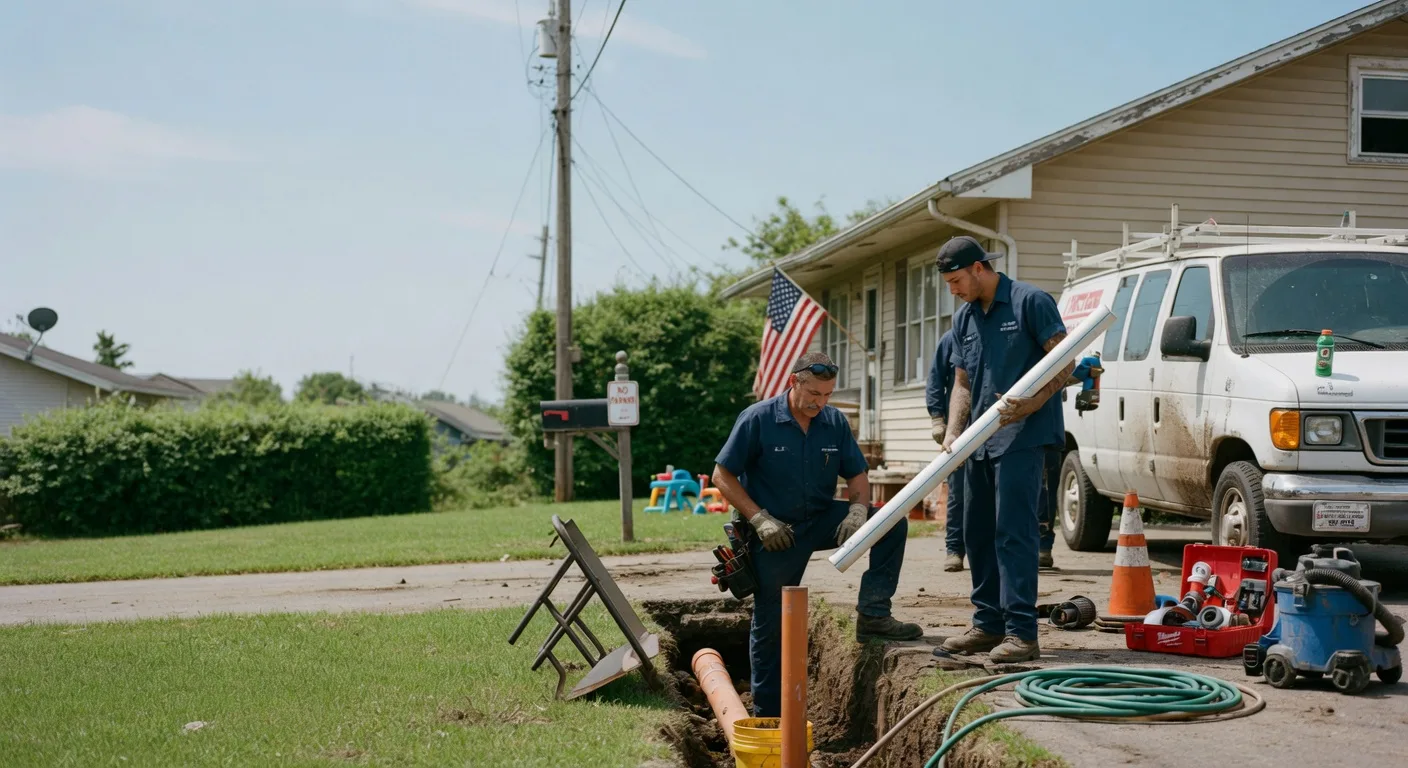
A clog that returns within days almost always means one of two things. Either the first cleaning opened a path without removing the whole blockage, or the real cause was never touched. A cable machine punches a channel through the middle of a clog. That restores flow, but it can leave a ring of grease, scale, or packed debris clinging to the pipe wall, and that ring catches the next load of waste quickly. Underneath that sit the causes a cable cannot fix: roots growing in at a clay joint, a bellied section holding standing water, a cracked or offset joint catching paper, or rough scale in cast iron. Start by noting whether it is one fixture or several. A single kitchen or bathroom line that refills fast often needs hydro jetting, which scours the full width of the pipe wall rather than opening a hole through the center. A repeat clog in the main, or several fixtures slowing together, needs a camera inspection, because it shows the pipe's condition instead of just clearing it again. Chemical cleaner between visits usually makes things worse for the next tool. Expert Plumbers Co connects homeowners in Redding, CA with an independent local plumber who can find out why the drain will not stay clear. Access to the line and how much of it must be opened up are what shape the repair.
Clearing a drain is not the end of the story, and knowing what to do afterward keeps the clog from coming back. Once a line is cleared, run hot water for a minute, then fill the sink and let it drain to check the flow. Use a drain strainer in showers and kitchen sinks to catch hair and food scraps before they enter the pipe. Keep a note of the date and what the plumber found, because a second clog in the same place within a few months is useful information. If hair is the cause, a monthly manual clean of the strainer and stopper helps more than any product. If the plumber mentions roots, a bellied pipe, or a cracked joint, ask what the options are and how quickly the problem is likely to return. Older homes often have cast iron or clay lines, where recurring trouble is more common than in newer plastic pipe.
What is the difference between a septic system and a city sewer line for drain problems?
The two systems fail in different places, so the first job is knowing which one your home has. A city sewer line carries wastewater from your house to a municipal main, so trouble is usually confined to the pipe: roots at a clay joint, a bellied section, scale in old cast iron, or a blockage in the lateral. Every drain in the house backing up at once typically means the private line or the connection at the street. A septic system adds a buried tank and a drain field. Solids settle in the tank, and liquid flows out through perforated pipe into the soil. Slow drains or backups can mean a tank that is full and overdue for pumping, a clogged outlet filter or baffle, a failing drain field that can no longer absorb water, or a blockage in the short line between the house and the tank. Soggy ground or a strong odor over the tank area points away from the house plumbing. A cable machine or hydro jetting can clear the house line on either system, but jetting into a septic line needs care about where the water and debris end up. Property paperwork, a cleanout location, or the water utility can tell you which system you have. Expert Plumbers Co connects homeowners with an independent local plumber who works on that type of system.
Homeowners often assume a septic problem and a city sewer problem look the same from the bathroom, but there are a few quick clues. On city sewer, a backup after heavy use is usually the private line or the lateral at the street, and neighbors on the same main may have had the same trouble. On septic, the problem tends to build slowly: drains slow down across the house, the toilet flushes weakly, and a patch of lawn stays wet or unusually green. A common mistake is pouring additives into a septic tank hoping to fix a failing drain field. They do not repair soil that has stopped absorbing water. When you call, tell the plumber how old the system is, when the tank was last opened, and where the cleanout or lid sits. In older homes the tank may be buried deeper than expected and need to be located first, which adds time before any repair starts.
The toilet flushes slowly but never fully clogs. What is going on?
The toilet flushes, the bowl drops slowly, and it creeps back up before settling. It never fully clogs, so it is easy to ignore. Do not ignore it.
A slow flush means something is partly in the way. There are three common causes. First, the trap or the pipe just past it is narrowed by paper, wipes, or grease and soap scale on the pipe wall. Second, the vent stack on the roof is partly blocked, so air cannot follow the water down. You may hear gurgling or see the bowl bubble. Third, the branch line is bellied, or has roots at a joint, and water moves through it slowly.
Check one thing first: is it only this toilet, or are the tub, sink and other toilets slow too? One slow fixture points to that fixture's branch. Slow everywhere points to the main line or lateral, which is a different job with different equipment.
Safe homeowner check: use a plunger, stop flushing wipes, and watch whether it comes back. Stop running water and call now if other drains gurgle when you flush, water rises in a tub, or there is a sewage smell in the house.
A cable machine usually clears a single branch. Recurring slowness, roots or grease often call for hydro jetting, and a camera inspection shows which. Expert Plumbers Co is a referral service. Call (380) 262-9173 to be connected with a plumber in Redding, CA for Drain Cleaning.
A slow flush that gets worse over a few weeks is a sign that the cause is growing, not stable. If the water is also making a gulp or a bubble in a nearby sink or tub when you flush, that points toward air being pulled through a trap, which is the vent stack problem. Check whether the slowness is worse during heavy rain or after the washing machine runs, because that tells the plumber whether the main line is filling up. Do not keep adding more water in the hope that the extra weight will push the blockage through, since it can drive waste up into the lowest opening. Tell the plumber if the toilet was recently moved, replaced or fitted with a water-saving model, because a low-flow toilet on an old line with little fall can leave solids behind. In older homes, the toilet branch is often a long run with a modest slope, which makes it more likely to hold debris.
The toilet is clogged. When is a plunger enough, when do I need a closet auger, and when is it the main line?
A plunger is enough when the bowl is slow or full but the clog is close, usually paper or a bit too much of everything. Use a flange plunger that seals over the drain opening. Push gently first to push out the air, then pump firmly for 15 to 20 strokes. If the water drops and the toilet flushes freely, that was it. Do not flush again until the bowl has drained.
A closet auger is the next step when the plunger fails twice or the toilet clogs again right away. It is a short cable with a curved head made to pass through the toilet's trap without scratching the porcelain. Feed it in, turn the handle, and pull back out whatever it catches. It reaches a clog the plunger cannot pull or push, such as a wad of wipes or a solid object.
It may be the main line when the toilet is not the only sign. Look for these:
Other drains are slow too.
The tub or shower gurgles or backs up when the toilet is flushed.
Water rises in a floor drain or low fixture.
A plunger and an auger give no lasting relief.
If you plunge and water or sewage comes up in the tub or another fixture, stop. Do not keep flushing. The blockage is past the toilet, in a branch or the main sewer line, and more water only pushes it into the house.
Stop and call if sewage is spreading on the floor, or if you hear gurgling and smell sewage. Clearing a main line may call for a cable machine, hydro jetting or a camera, depending on what is in there and how often it returns. Cost depends on access to a cleanout, how far the machine has to travel and what is found.
Avoid chemical cleaners in a standing toilet. They do not move a solid clog and they splash onto skin and eyes.
Expert Plumbers Co can connect you with an independent plumber in Redding, CA for this: call (380) 262-9173.
Do enzyme or bacterial drain treatments actually work?
Your drain is slow and the bottle on the shelf says it eats clogs. Does it work? A little, in the right situation, and no for most clogs people buy it for.
Enzyme and bacterial products break down organic film: grease, soap residue, food particles and the slimy layer that builds on the inside of a pipe. They work slowly, over days and repeated doses. Used that way, they help keep a clean line clean.
What they cannot do is just as important. They will not dissolve a hairball in a tub trap, a wad of wipes, a child's toy or a solid plug. They do nothing to tree roots growing into a clay joint. They cannot lift a bellied line that holds water, flatten a collapsed section, or seal a cracked pipe. Scale inside old cast iron is mineral, not organic, so it does not respond either.
If one fixture is slow, the cause is usually local: hair, soap scum or grease in that trap or branch. If every drain in the house is slow, or water backs up in the lowest fixture when you run the washer, the problem is in the main line, and a bottle from the shelf will not reach it.
Safe homeowner check: remove the stopper or strainer and clear what you can by hand. Try a plain plunger. Flush with hot tap water, not boiling, which can soften or damage some pipe and fittings. If you use an enzyme product, follow the label, usually at night when the drain sits unused. Do not mix it with chemical openers.
Stop running water and call now if sewage or gray water comes up in a tub, shower or floor drain, if the toilet and the sink back up together, if gurgling comes from several fixtures.
A cable machine is enough for a single soft clog or a simple plug in one branch. If the line keeps slowing down, a plumber may suggest hydro jetting to clean the full pipe wall, or a camera inspection to see roots, a belly or a damaged joint before anything else is done.
Expert Plumbers Co is a referral service. We connect you with an independent local plumber in Redding, CA. Call (380) 262-9173.
Ask the plumber what they found on the pipe wall, not just whether the water now runs. If it was grease or film, ask whether a maintenance routine makes sense for your line. If it was roots, a belly or damage, ask what repair is involved. The scope depends on access to the pipe, the materials needed, how much has to be opened up, and any permit or code requirement.